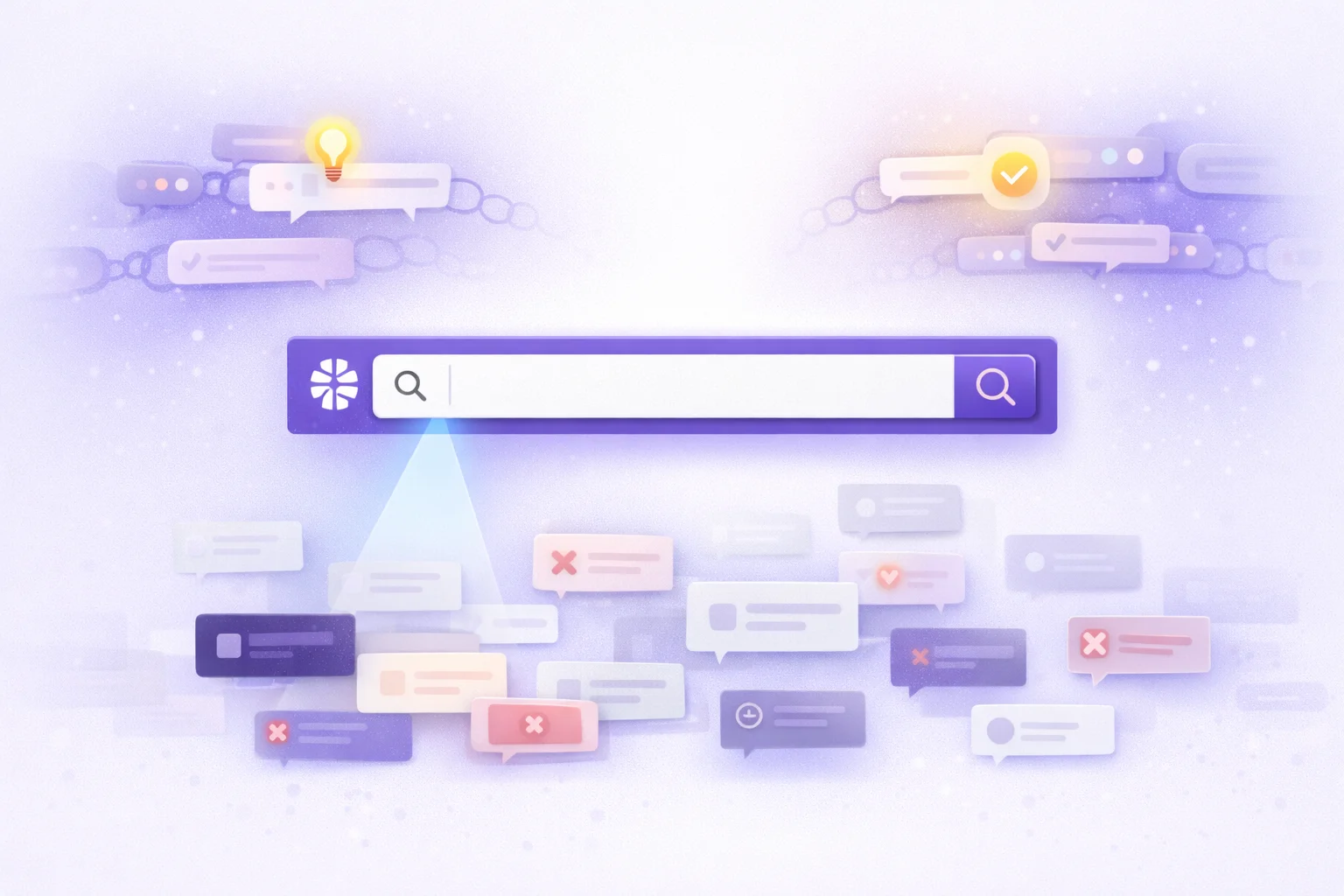
You've been there. You know someone discussed the API rate limiting strategy last week. You open Slack, type "rate limit" into search, and get 47 results spread across 6 channels and 3 months. None of them are the message you're looking for.
Slack's search is technically functional — it finds messages containing your keywords. But finding messages and finding knowledge are two completely different problems.
The difference between messages and knowledge#
A message is raw text: "let's go with option B for the rate limiter." Knowledge is the context around that message: what options were considered, why B was chosen, who decided, what trade-offs were accepted, and which systems are affected.
Slack search finds the message. It doesn't find the knowledge.
The conversation might look like this:
@sarah: We need to decide on rate limiting. Option A is per-IP, Option B is per-token with a sliding window @mike: Option B is more complex but handles our burst traffic better @sarah: Agreed. The Redis implementation for B is straightforward @mike: Let's go with B. I'll create the ticket
Search for "rate limit" finds this thread — if you're lucky. But search for "why did we choose sliding window" returns nothing, because nobody used those exact words in the decision.
5 reasons Slack search fails for knowledge#
1. Decisions are expressed conversationally#
Teams don't write "DECISION: We will use Option B for rate limiting." They say "yeah let's go with B" or simply react with a checkmark emoji. Slack search can't index intent, only text.
2. Context spans multiple messages#
A decision in Slack is rarely a single message — it's a thread of 10-30 messages where context builds over time. Slack search returns individual messages, not conversation arcs. You find one message in the middle and have to manually reconstruct the full context.
3. Same words, different meanings#
Search for "deploy" and you'll find deployment announcements, deploy failures, deployment strategy discussions, and someone asking "when do we deploy the new API?" Slack has no concept of semantic search — it's pure keyword matching.
4. People don't tag decisions#
Some teams try to solve this with emoji reactions (🚨 for important, ✅ for decisions). But this requires every team member to consistently apply the same system. In practice, tagging compliance drops below 30% within a month.
5. Time decay makes search harder#
Slack search is biased toward recent messages. Finding a decision from 3 months ago requires scrolling through pages of results. If your team generates 500+ messages per day, that's 45,000+ messages to search through for a single quarter.
What actually works#
The core problem isn't Slack's search algorithm — it's the approach. Searching for knowledge after the fact is fundamentally harder than capturing it as it happens.
Reactive approach (search): Wait until you need information → search for it → reconstruct context from fragments → hope you find the right thread.
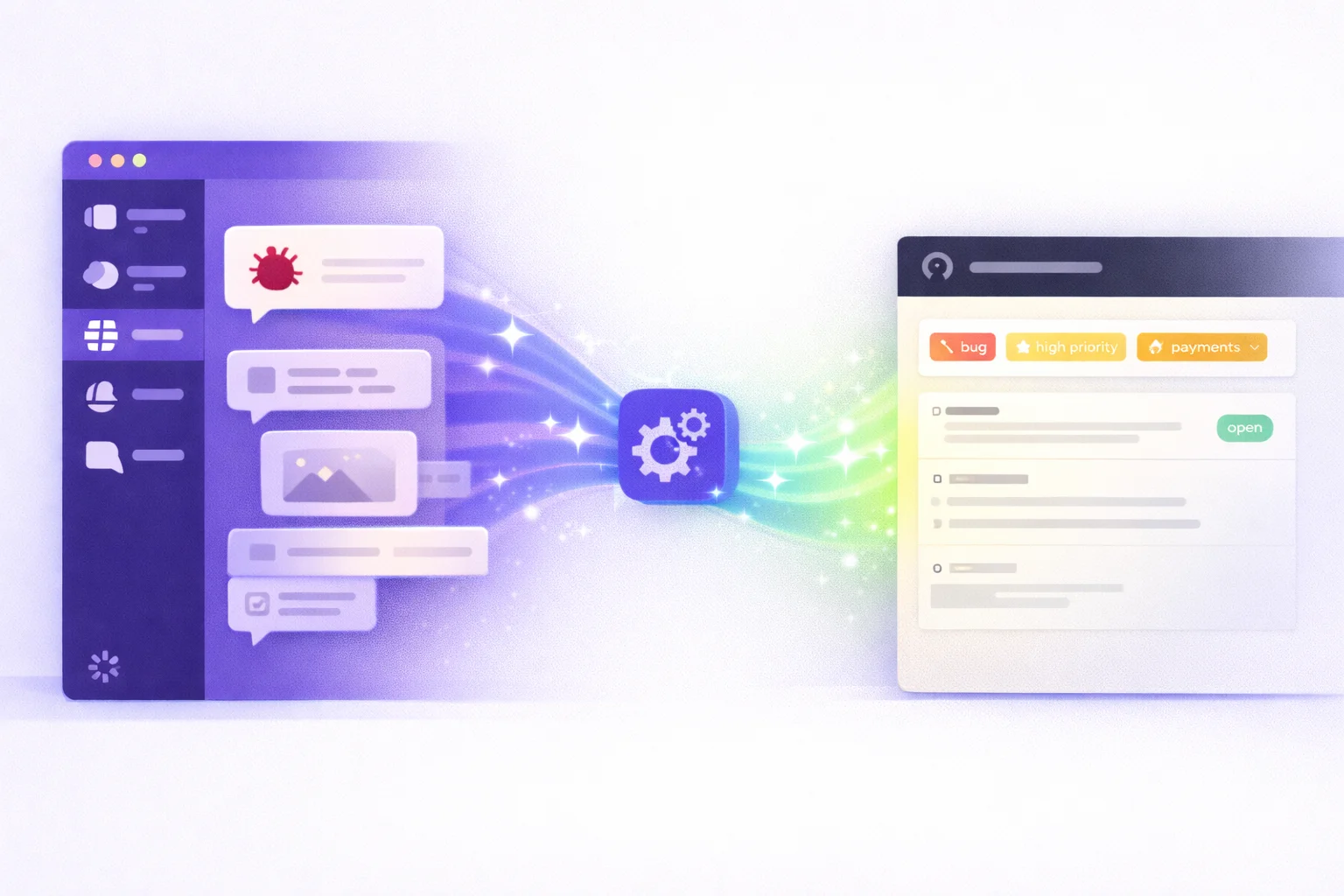
Proactive approach (routing): Automatically identify important discussions → classify them by type → route them to the right tool → knowledge is always where you expect it.
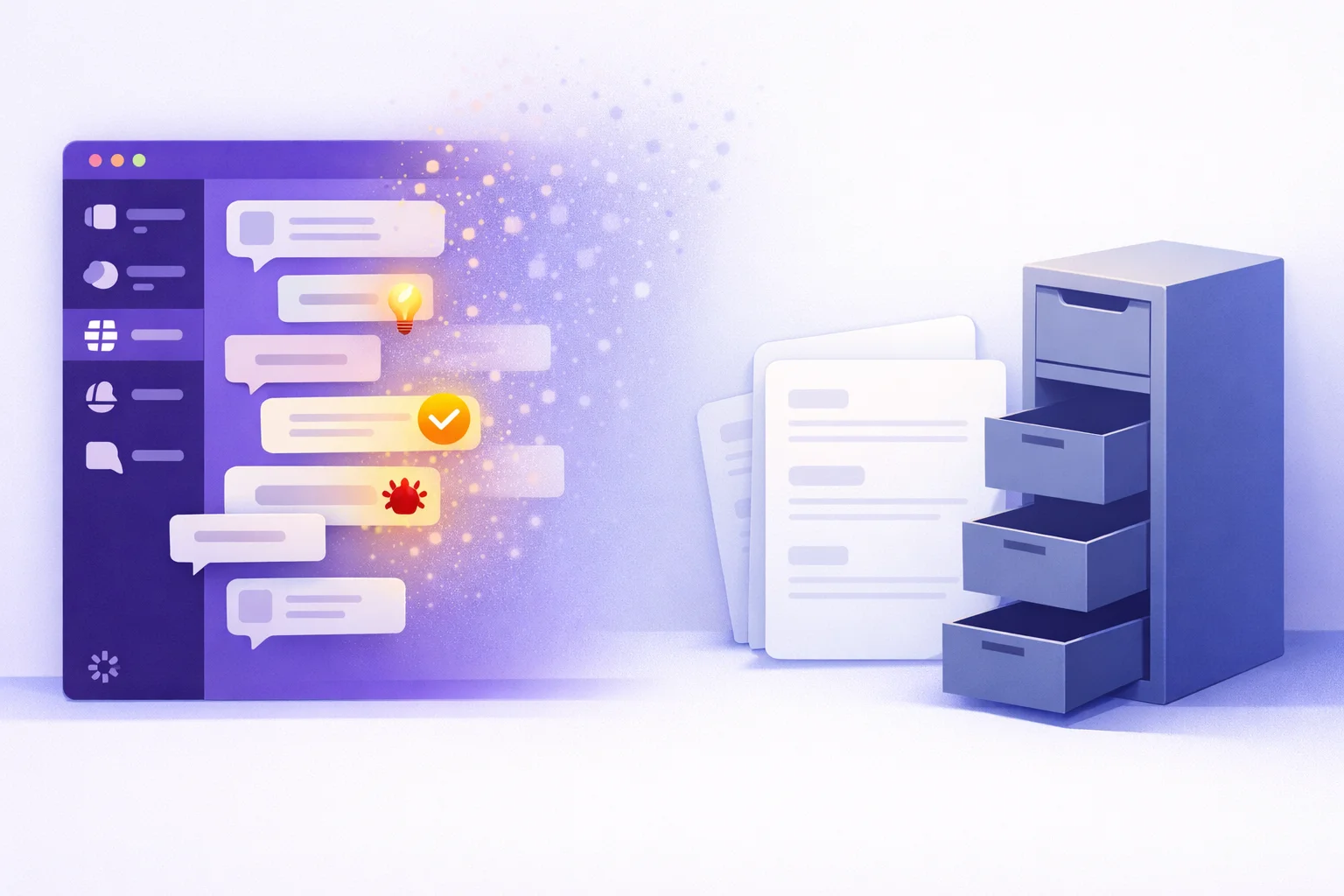
This is the difference between a filing cabinet (search through everything when you need something) and a mail sorter (everything goes to the right place automatically).
How AI-powered routing solves what search can't#
AI classification doesn't rely on keywords or tags. It understands intent:
- "let's go with option B" → Decision about rate limiting architecture
- "users are seeing 500 errors on the checkout page" → Bug report requiring investigation
- "we should consider switching to PostgreSQL 17" → Idea for future evaluation
- "the deployment process requires running migrations first" → Process knowledge for documentation
ThreadMemory's AI pipeline analyzes full conversation context — not individual messages — to determine what's important, what type of knowledge it represents, and where it should go.
Instead of searching Slack later and hoping you find the right message, the decision is already in Notion. The bug is already in Jira. The process doc is already in Confluence.
The bottom line#
Slack search is a message finder, not a knowledge finder. If your team keeps asking "didn't we already discuss this?" or "where was that decision made?" — the problem isn't that Slack search is broken. The problem is that search is the wrong tool for knowledge management.
The fix isn't better search. It's automatic routing.